
Astromicelio
Astromicelio is a web app for studying natal charts methodically. It does not interpret for you or generate automatic texts: it calculates the chart, lets you write about one specific position and keeps that note anchored there, to hand it back when the same configuration reappears in another chart.
It is built for people who accumulate material over years — practising astrologers, study groups and students — hence the identities, the cores, the studies shared with permissions, the family trees and a change history that lets you undo.
Features
Interactive natal chart with overlaid rings: transits, secondary progressions, solar arc, draconic chart and solar return.
Markdown notes anchored to a specific planet, sign, house or aspect, grouped into cores and with reusable templates.
Synastries with composite chart, Davison chart and an aspect table with an affinity index.
Case studies to compare several charts, shareable with read or edit permission, with comments and notifications.
Astrogenealogy: a family tree with each member’s chart and the relationships — siblings, grandparents, uncles, cousins — computed on their own.
Timelines of life events with categories and dates, overlaid with historical events to read them against the transits.
Pattern heat map: which planets, signs and houses concentrate each person’s notes.
Full-text search across every note, change history with undo, printable reports and PDF export.
Technologies used
The note hangs off the configuration, not the folder
Every note is stored under a canonical position key — planet, sign, house, aspect or angle — so years of writing reuse themselves: the material comes back the moment that same configuration appears in another chart.
The chart engine is a reusable piece of its own
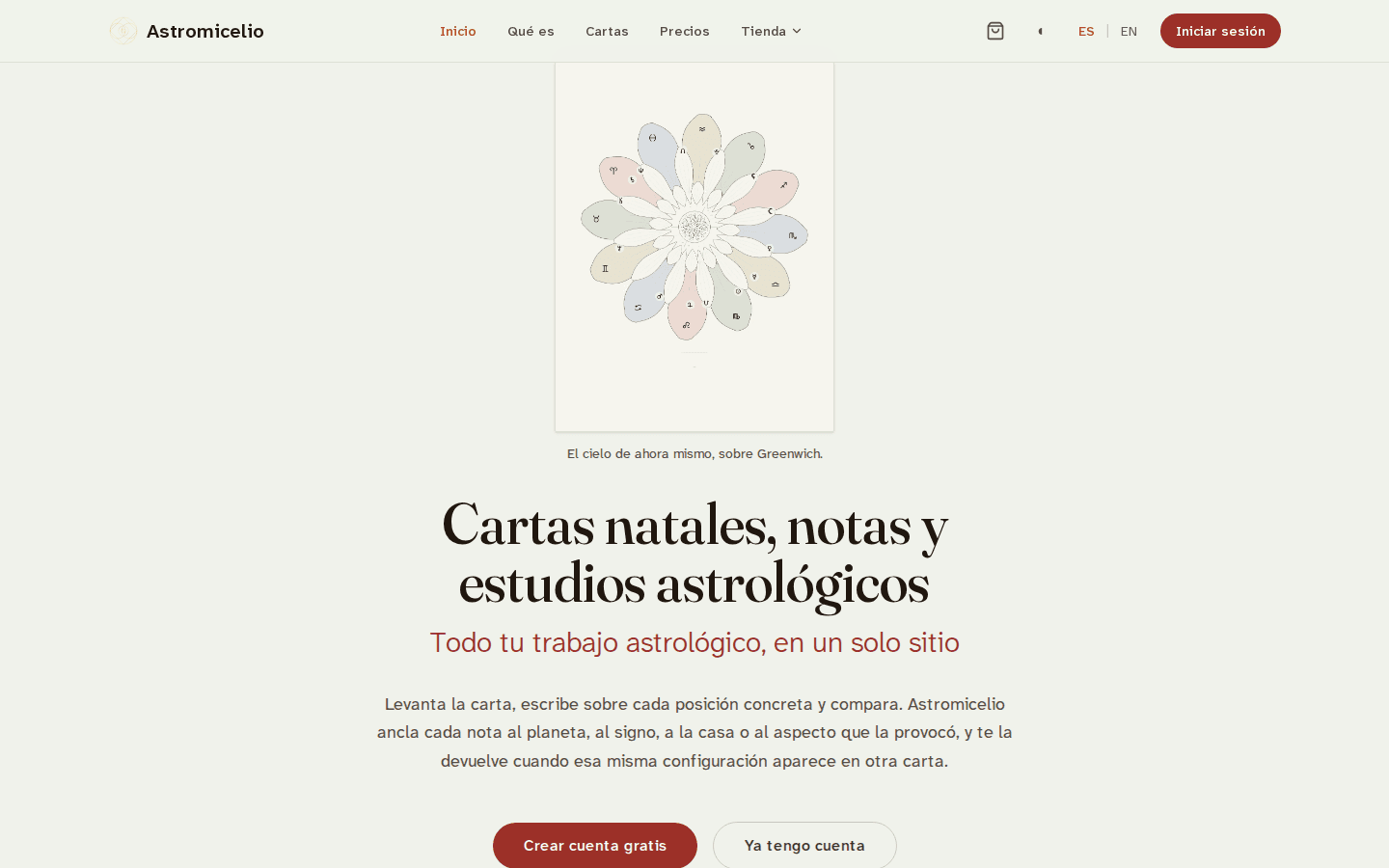
The visualisation lives in Astromandala, a standalone library of pure SVG geometry with declarative rings and themes. It does not impose the ephemeris: the calculation is injected from outside and runs in the browser, so it can be swapped without touching the drawing.
One permission layer, shared studies included
Everything that touches an identity’s data goes through the same authorisation layer, which also resolves whose notes are whose when a study is shared: opening someone else’s study shows the owner’s notes, never mixed with your own.
A proven foundation for projects like…
- Schools and study groups that need to share charts and notes with permissions, comments and reports.
- Practitioners who accumulate material about their clients and want to retrieve it by configuration rather than by folder.
- Any product where notes should hang off a computed object instead of a loose document: clinical records, technical analyses, cataloguing.
No fixed rates: every project is quoted on its real scope.